Are you tired of the noise, fumes, and constant maintenance that come with traditional gas-powered lawn mowers? The evolution of battery technology has revolutionized lawn care, offering a cleaner, quieter, and more convenient alternative. In 2026, battery-powered lawn mowers stand out as powerful, efficient, and eco-friendly solutions for every yard size. This comprehensive guide will help you navigate the latest models, understand their features, and choose the perfect battery lawn mower to keep your lawn looking pristine with minimal effort.
An Overview of Lawn Mowers
A lawn mower is a machine designed to cut grass to an even height, essential for maintaining a tidy and healthy lawn. From early hand-pushed reel mowers to the robust machines we see today, lawn mower technology has continuously advanced, making yard work less strenuous and more efficient.
Historically, gas-powered models dominated the market, offering substantial power for large areas. However, concerns over noise pollution, exhaust emissions, and extensive maintenance led to the development of electric alternatives. Initially, these were corded, limiting mobility. The true game-changer has been the rise of cordless, battery-powered lawn mowers. These modern machines offer the freedom of movement found in gas models, combined with the eco-friendliness and ease of electric operation, making them a popular choice for homeowners seeking convenience and performance.
Classifying Battery Powered Lawn Mowers
Battery-powered lawn mowers come in various configurations, each designed to suit different lawn sizes, terrains, and user preferences. Understanding these types will help you narrow down the best choice for your specific needs.
Push Battery Mowers
Push battery mowers are manually propelled, requiring the user to push them across the lawn. They are typically lighter and more compact than self-propelled or gas models, making them highly maneuverable around obstacles, tight corners, and garden beds. These mowers are ideal for smaller lawns (up to 200-400 square meters) where extensive power isn’t the primary concern. They often boast simpler designs, which can translate to a lower initial cost. The main considerations are the physical effort required and the battery runtime, which might be limited to 30-60 minutes on a single charge.
Self-Propelled Battery Mowers
For those with medium to larger lawns or uneven terrain, self-propelled battery mowers offer a significant advantage. These models feature a drive system that propels the mower forward, reducing the physical exertion needed to cut the grass. This makes them especially useful on slopes or for extended mowing sessions. While heavier than push mmowers, their self-propulsion vastly improves user comfort and efficiency. Many top-rated battery lawn mowers, like the EGO Power+ Select Cut XP, fall into this category, balancing power, runtime, and ease of use for substantial yards.
Riding Battery Mowers
Stepping up in scale, riding battery mowers are designed for very large properties, often exceeding half an acre. These machines, including electric lawn tractors and zero-turn mowers, offer the power equivalent to traditional gas engines but with electric advantages. They feature wider cutting decks, significantly reducing mowing time for expansive areas. While the initial investment is higher (ranging from $3,000 to $8,000), they provide unmatched convenience for substantial landscapes. Advanced models often come with multiple high-capacity lithium-ion batteries to ensure extended runtimes.
Robotic Battery Mowers
For the ultimate hands-free experience, robotic battery mowers autonomously cut your lawn. Once programmed, these smart devices navigate your yard, trim the grass, and return to their charging station, all without supervision. They are perfect for homeowners who want consistent lawn maintenance without any effort. While they represent a significant upfront investment and are best suited for relatively flat, obstacle-free lawns, robotic mowers offer unparalleled convenience and year-round lawn health with minimal intervention.
Battery Voltage and Power
The voltage (V) of a battery-powered lawn mower is a crucial indicator of its power and suitability for different tasks.
- 18V/24V Mowers: Often found in compact models, these are suitable for small courtyards and lawns up to 200 square meters, providing enough power for light-duty cutting.
- 40V Mowers: A common standard, 40V systems offer a good balance of power and runtime for small to medium-sized lawns (up to 400-500 square meters). Brands like Ryobi and Worx often feature robust 40V lineups.
- 60V/80V Mowers: These high-voltage systems are designed to rival gas-powered performance, making them ideal for medium to large lawns (over 500 square meters) or tackling thicker, taller grass. They provide a heavy-duty solution and are often paired with larger cutting decks and self-propelled features. Greenworks is notable for its powerful 80V offerings. The higher the voltage, generally the more power and potentially longer runtime, though this also depends on the Amp-hour (Ah) rating of the battery.
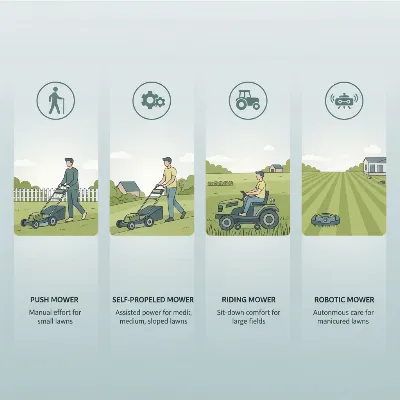 An illustrative infographic showing different types of battery-powered lawn mowers: push, self-propelled, riding, and robotic, with small icons representing their ideal use cases.
Comparison Table of Battery Powered Lawn Mowers
Choosing the right battery-powered lawn mower involves weighing several factors. This table provides a quick comparison across common types based on key performance indicators for 2026 models.
| Feature | Push Battery Mower | Self-Propelled Battery Mower | Riding Battery Mower (Zero-Turn/Tractor) | Robotic Battery Mower |
|---|---|---|---|---|
| Ideal Lawn Size | Small (up to 400 sqm) | Medium to Large (400-1000 sqm) | Very Large (1000+ sqm) | Small to Medium (up to 1000 sqm) |
| Average Price Range | $200 – $500 | $400 – $800 | $3,000 – $8,000 | $800 – $2,500 |
| Power/Performance | Good for light to moderate grass | Strong, handles varied conditions | Excellent, comparable to gas | Consistent, light trimming |
| Runtime | 30-60 minutes | 45-90 minutes | 90-180 minutes | Continuous (returns to charge) |
| Noise Level | Very Low | Low | Moderate (quieter than gas) | Extremely Low |
| Maintenance | Very Low | Low | Moderate (battery & motor checks) | Low (cleaning, blade, software) |
| Ease of Use | Simple, lightweight | Effortless propulsion | Requires driving skill | Fully autonomous |
| Key Features | Compact, easy storage | Variable speed, mulching, bagging | Wide deck, high power, accessories | Scheduling, GPS, anti-theft |
Reputable Battery Lawn Mower Brands
The battery-powered lawn mower market is robust, with several brands consistently delivering high-quality, innovative products. Here are some of the most trusted names and their strengths in 2026:
- EGO Power+: Often topping review lists, EGO Power+ is lauded for its raw power, long battery life, and excellent cut quality, making grass look like “velvet after a trim.” Their 21-inch Select Cut XP model is a standout, and the Z6 zero-turn offers substantial power for larger properties.
- Ryobi: Known for offering great value, Ryobi provides a strong lineup of 40V mowers. They are a reliable choice for homeowners seeking a balance of performance and affordability, often including two batteries with purchase for extended runtime.
- Worx: Worx excels in providing compact and maneuverable options, such as their 40V 14-inch mower, ideal for small yards or navigating tight spaces. Their models are lightweight and easy to store.
- Toro: Toro mowers are highly recommended for their exceptional build quality and superior cut quality, particularly their Recycler series. They are known for efficiency, delivering excellent square footage mowed per amp-hour of battery capacity.
- DeWalt: DeWalt’s 60V Max mowers are praised for their power and ease of use, often featuring robust construction suitable for tougher tasks.
- Bosch: Bosch battery mowers, like the UniversalRotak and AdvancedRotak series, are recognized for their cutting-edge technology, user-friendly features, and quiet operation thanks to ProSilence technology. They offer great versatility for small to medium-sized lawns.
- Husqvarna: Husqvarna offers brilliant compact mowers, such as the Aspire LC34-P4A, which packs down tiny for easy storage, making it perfect for smaller lawns.
- Cobra & Hyundai: These brands are gaining traction, with models like the Cobra MX4140v praised for its excellent build quality and steel deck, providing a “petrol mower feel” without the emissions. The Hyundai HYM80LI460SP is noted for its high power (80V) and versatility for larger lawns.
> “The advancements in battery technology mean that today’s cordless lawn mowers offer power and runtime that genuinely compete with, and in many cases surpass, the convenience of their gas-powered predecessors. Homeowners no longer have to compromise performance for sustainability.” – Alex Stone, Senior Product Engineer at GreenTech Innovations
Your Buying Guide to Battery Lawn Mowers
Choosing the best battery-powered lawn mower requires careful consideration of several factors to ensure it perfectly matches your lawn care needs.
Assess Your Lawn’s Needs
Begin by evaluating your lawn’s characteristics.
- Size: For small lawns (under 400 square meters), a lightweight push mower with a 14-inch to 18-inch cutting deck and a 24V or 40V battery might suffice. Medium lawns (400-1000 square meters) will benefit from self-propelled 40V or 60V models with wider decks (18-inch to 21-inch). For very large lawns (over 1000 square meters), consider high-voltage self-propelled mowers, or even riding mowers, with longer runtimes and larger cutting widths.
- Grass Type: Thicker, tougher grass requires more power. Higher voltage (60V or 80V) and robust brushless motors will perform better.
- Terrain: Flat lawns are suitable for any mower. Sloped or uneven terrain strongly favors self-propelled models to reduce user fatigue and ensure consistent cutting.
Budget Considerations
Battery-powered lawn mowers generally have a higher initial upfront cost compared to basic gas models, but they offer significant long-term savings on fuel and maintenance. Prices can range from $200 for basic push models to several thousand for riding or advanced self-propelled units. Remember to factor in the cost of spare batteries if longer runtimes are crucial, as well as any specific attachments you might need.
Essential Features
Modern battery mowers come with a host of features designed to enhance your mowing experience:
- Cutting Height Adjustment: Look for easy-to-use, centralized height adjustment systems that offer a wide range of settings (e.g., 25mm to 75mm) to suit different grass lengths and seasons.
- Cutting Deck Size: A wider cutting deck means fewer passes, saving time. Match the deck size to your lawn area.
- Mulching, Bagging, and Side Discharge: Many models offer multiple clipping disposal options. Mulching finely chops grass, returning nutrients to the lawn, while bagging collects clippings for disposal. Side discharge is useful for very tall grass.
- Self-Propelled Function: Essential for larger lawns or sloped yards, reducing physical effort. Look for variable speed options for better control.
- Battery System: Consider the battery voltage (V) and Amp-hour (Ah) rating for runtime. A removable battery that is interchangeable with other tools from the same brand (e.g., EGO Power+ or Ryobi’s ecosystem) adds tremendous value.
Durability and Maintenance
A durable mower will have a robust deck (steel is preferred for longevity, though many battery mowers use durable plastic composites) and quality components. Battery-powered mowers inherently require less maintenance than gas models, but ease of cleaning and blade replacement should still be considered. Look for brushless motors, which are more efficient and have a longer lifespan.
Brand Reputation and User Reviews
Stick to reputable brands known for quality and customer support, such as those listed above. Reading recent user reviews can provide valuable insights into real-world performance, battery life, and common issues. Local dealer support can also be a plus for maintenance and parts.
Prioritizing Safety
Always choose a mower with robust safety features, including an instant start/stop mechanism and blade brake. Wear appropriate safety gear, such as eye protection and sturdy footwear, and ensure children and pets are clear of the mowing area during operation. Familiarize yourself with the owner’s manual for safe use and maintenance.
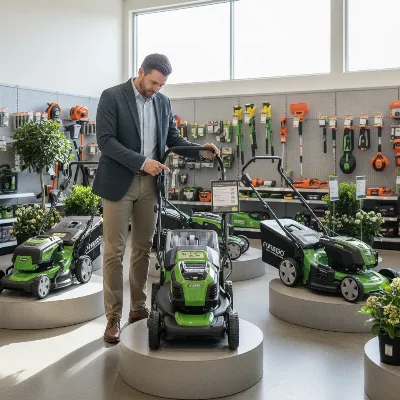 A person evaluating different battery-powered lawn mowers in a garden center, considering factors like lawn size, features, and battery type.
Using and Maintaining Your Battery Lawn Mower
Proper use and routine maintenance are key to maximizing the performance and lifespan of your battery-powered lawn mower.
Safe Operation Guidelines
Before each use, perform a quick visual inspection:
- Remove Debris: Clear the lawn of any sticks, stones, toys, or other objects that could be thrown by the blades.
- Check Battery: Ensure the battery is fully charged and securely seated in its compartment. Always use the charger supplied with your mower.
- Inspect Blades: Check blades for sharpness and damage. Dull blades tear grass, leading to an unhealthy-looking lawn.
- Wear Safety Gear: Always wear sturdy closed-toe shoes, long pants, and eye protection.
- Mow Safely: Avoid mowing wet grass, as it can clog the deck, strain the motor, and pose a slip hazard. Operate the mower with both hands and never disable safety features. Keep a safe distance from children and pets.
Routine Maintenance
Battery-powered mowers are low-maintenance, but some regular tasks are essential:
- Clean After Each Use: Disconnect the battery and use a brush or damp cloth to remove grass clippings and dirt from the deck, underside, and motor housing. This prevents rust, corrosion, and clogs.
- Blade Care: Sharpen or replace blades periodically (at least once a season, more often if used frequently or on tough grass). Sharp blades ensure a clean cut and reduce strain on the motor and battery.
- Battery Maintenance:
- Charge After Every Use: Avoid letting the battery fully discharge. Recharge it promptly to extend its lifespan.
- Avoid Overcharging: Unplug the charger once the battery is full to prevent damage. Many modern chargers have intelligent systems to prevent this.
- Proper Storage: During the off-season, store the battery in a cool, dry place (ideally between 4°C and 20°C). Disconnect it from the mower and check its charge every 4-6 weeks, topping it up if necessary. Do not store in direct sunlight or damp areas.
- Motor Inspection: Regularly check the motor housing for debris and ensure ventilation openings are clear to prevent overheating.
Troubleshooting Common Issues
- Mower Won’t Start: Check battery charge, ensure it’s properly inserted, and verify the safety key is engaged (if applicable).
- Reduced Runtime: Battery may be aging, or grass might be too tall/wet, requiring more power. Ensure blades are sharp.
- Uneven Cut: Inspect blades for dullness or damage. Ensure cutting height settings are even.
- Mower Overheats: Clear grass clippings from the deck and motor vents. Avoid pushing the mower beyond its limits, especially in thick grass.
Conclusion
The landscape of lawn care has significantly evolved, with battery-powered lawn mowers leading the charge towards a more sustainable and convenient future. In 2026, these innovative machines offer impressive power, extended runtimes, and a host of user-friendly features, all while reducing noise, emissions, and maintenance headaches. Whether you manage a compact urban garden or a sprawling suburban estate, there’s a battery lawn mower designed to meet your specific needs, from agile push models to powerful self-propelled units and even autonomous robotic systems. By carefully considering your lawn size, desired features, and committing to simple maintenance routines, you can enjoy a beautifully manicured lawn with less effort and a greater peace of mind. Why not make the switch and experience the quiet revolution in your own backyard?
Frequently Asked Questions
How long do battery-powered lawn mower batteries typically last on a single charge?
The runtime of a battery-powered lawn mower varies greatly depending on the battery’s voltage and Amp-hour (Ah) rating, the lawn size, grass height, and terrain. Most models offer between 30 to 90 minutes of continuous operation, with some high-capacity riding mowers extending to 1.5 to 3 hours. Many brands provide interchangeable batteries, allowing users to swap a depleted battery for a fresh one to extend mowing time.
Are battery-powered lawn mowers powerful enough for large lawns or thick grass?
Absolutely. Modern battery-powered lawn mowers, especially those with 60V or 80V systems and brushless motors, are designed to tackle medium to large lawns and even thick or tall grass with comparable power to many gas-powered models. For very large properties, electric riding mowers are available. Key factors for performance are battery voltage, motor type, and blade design.
What is the average lifespan of a battery in a cordless lawn mower?
The average lifespan of a lithium-ion battery in a cordless lawn mower is typically three to five years, or several hundred charge cycles, depending on usage frequency and proper maintenance. Factors like consistent charging habits (avoiding deep discharges and overcharging) and storing the battery in a cool, dry place during the off-season can significantly extend its overall life.
Get our weekly buyer guide
Practical specs, not advice. Unsubscribe anytime.
