The top 5 robot lawn mowers for smart homes in 2026 are the Segway Navimow X390, Husqvarna Automower 435X AWD, Ecovacs Goat A3000, Mammotion LUBA mini AWD, and Eufy Lawnbot E18. These models offer advanced features like precise GPS navigation with RTK support, all-wheel drive for challenging slopes, and seamless integration with smart home ecosystems, providing convenience and efficient lawn maintenance for modern homeowners.
Understanding Robot Lawn Mowers and Smart Home Integration
Robot lawn mowers are autonomous devices designed to cut grass without human intervention, functioning much like their indoor counterparts, robot vacuums. Their primary purpose is to maintain a consistently neat lawn, freeing up homeowners’ time and reducing physical effort. The earliest models were basic, often relying on perimeter wires and simple collision detection to navigate. However, the landscape has significantly shifted in recent years, with these machines evolving from rudimentary gadgets into sophisticated smart home appliances.
The history of robot lawn mowers dates back to the early 1990s, but it’s in the last decade that they’ve truly come into their own. Advancements in battery technology, GPS, AI, and connectivity have transformed them. Today, the market boasts a diverse range of robot lawn mowers, broadly categorized by their navigation methods—from traditional boundary wire systems to advanced wire-free solutions utilizing GPS, RTK (Real-Time Kinematic), LiDAR, and camera vision. The key differentiator for modern models, especially those designed for smart homes, is their ability to connect, communicate, and be controlled through various smart home platforms, offering unparalleled convenience and automation. For compare top lawn mower on this site.
Key Features of Smart Robot Lawn Mowers
The intelligence of a robot lawn mower lies in its advanced features that enable autonomous and efficient operation, particularly within a smart home environment. Understanding these capabilities is crucial when evaluating which model best suits your needs.
Advanced Navigation Systems
Modern robot lawn mowers employ sophisticated navigation technologies to precisely map your lawn and execute cutting patterns. GPS (Global Positioning System) allows them to track their location, while RTK provides centimeter-level accuracy, essential for large or complex yards. LiDAR (Light Detection and Ranging) and camera vision enable real-time 3D mapping and superior obstacle avoidance, allowing the mower to detect and navigate around pets, toys, or garden furniture. These wire-free technologies eliminate the cumbersome installation of physical boundary wires, simplifying setup and increasing flexibility.
Seamless Smart Home Connectivity
True smart robot lawn mowers offer robust connectivity options, integrating smoothly with your existing smart home ecosystem. Wi-Fi and Bluetooth are standard for local control and app-based management. Many high-end models now include cellular connectivity, allowing you to monitor and control your mower from anywhere in the world, without relying on your home Wi-Fi network. Compatibility with voice assistants like Amazon Alexa or Google Home, and platforms like IFTTT, allows for automation routines, such as pausing mowing when rain is detected or scheduling cuts based on weather forecasts.
Obstacle Avoidance and Safety Features
|
Our Picks for the Best Lawn Mower in 2026
As an Amazon Associate I earn from qualifying purchases.
|
||
| Num | Product | Action |
|---|---|---|
| 1 | American Lawn Mower Company 50514 14" 11-Amp Corded Electric Lawn Mower, Black |

|
| 2 | LawnMaster MEB1114K Electric Corded Lawn Mower 15-Inch 11AMP |
|
| 3 | VEVOR Push Lawn Sweeper, 21inch Leaf & Grass Collector, Heavy Duty Thickened Steel Durable to Use with Large Capacity 3.5 cu. ft. Mesh Collection Hopper Bag, 2 Spinning Brushes |
|
| 4 | CRAFTSMAN Electric Push Lawn Mower, 20-Inch Deck, Corded, Powerful 13-AMP Motor, 6 Setting Height Adjustment, Winged Blades, 3 in 1 Bagging, Mulching and Discharge (CMEMW213) |
|
| 5 | Litheli 20V 13" Cordless Lawn Mower, Electric Lawn Mowers for Garden, Yard and Farm, 5 Heights, with Brushless Motor, 4.0Ah Battery & Charger Included |
|
| 6 | Litheli 40V (2 x 20V) 16" Electric Lawn Mower Cordless, Brushless Lawnmower with 6-Height Adjust, Portable & Lightweight Push Battery Powered Lawn Mower (2 * 4.0AH Batteries Included) |
|
| 7 | Greenworks 24V 13" Brushless (Push) Cordless Lawn Mower, 4.0Ah Battery and Charger |
|
| 8 | LawnMaster MEB1216K Electric Lawn Mower 16-Inch 12AMP |
|
| 9 | Litheli Electric Lawn Mower Cordless,Grass Cutter Machine for 1300 Sq.Ft.Lawnmower with Motor,13.2 in Cutting Width,8 Gallon Capacity,Cutting Height from 1 to 2.5 in with 4.0A Battery |
|
| 10 | Litheli 13.4inch Electric Lawn Mower Cordless,Grass Cutter Machine for 2600 Sq.Ft.Lawnmower with Brushless Motor, 8 Gallon Capacity, Cutting Height from 1 to 2.5 in, Includes 2X4.0 Ah Battery. |
|
Safety is paramount for any autonomous outdoor device. Smart robot lawn mowers incorporate various sensors (ultrasonic, bump, lift) and advanced AI to detect and avoid obstacles, preventing collisions with property, pets, or people. Lift sensors immediately stop the blades if the mower is picked up or tips over. Anti-theft systems, including PIN codes, audible alarms, and GPS tracking, provide peace of mind, allowing you to recover your investment if it goes missing. Rain sensors can automatically send the mower back to its charging station during inclement weather, protecting your lawn and the device itself.
Terrain Handling and Slope Capability
A key consideration for many homeowners is how well a robot mower can handle diverse terrain. Advanced models come equipped with powerful motors, all-wheel drive (AWD), or robust tread systems that allow them to tackle steep slopes and uneven ground. Proprietary traction control systems and articulated steering ensure consistent performance even on challenging inclines, a significant improvement over earlier rear-wheel drive models that struggled with anything but flat lawns.
Customization and Zone Management
Smart apps provide extensive control over your robot mower, allowing for highly customizable operation. You can easily set up virtual “no-go” zones for flower beds or delicate landscaping, define multiple mowing zones with different schedules, and adjust cutting heights to suit various grass types or seasonal needs. Some even offer “spot mowing” for particular areas that require extra attention, or intelligent mapping that learns your yard over time for optimized cutting paths.
Top 5 Best Robot Lawn Mowers for Smart Homes in 2026
Choosing the best robot lawn mower means finding a balance of innovative technology, reliable performance, and smart home integration. Based on extensive reviews and expert analysis for 2026, these five models stand out for their superior capabilities and intelligent features, making them ideal for the modern smart home.
Segway Navimow X390
The Segway Navimow X390 is often hailed as a top contender for larger lawns, capable of covering up to 2.5 acres. It boasts high-end features, including precise GPS navigation with RTK support, ensuring accurate positioning even in complex environments. Its cellular connectivity allows for remote control and monitoring from virtually anywhere, a significant advantage for smart home enthusiasts. The X390 incorporates advanced obstacle avoidance, rain sensors, and an anti-theft mechanism, providing both convenience and peace of mind. Its ability to automatically alternate cutting directions ensures a professionally groomed look for your lawn.
Husqvarna Automower 435X AWD
For homeowners with large, challenging yards featuring significant inclines, the Husqvarna Automower 435X AWD is an excellent choice. This all-wheel-drive powerhouse is specifically designed to handle steep slopes, utilizing articulated steering for superior maneuverability. Its connectivity suite includes Bluetooth, Wi-Fi, and GPS, enabling seamless control via its robust mobile app. Husqvarna’s reputation for reliability and durable construction shines through, making it a long-term investment. The 435X AWD also offers advanced anti-theft features and intelligent weather timers, ensuring optimal cutting in various conditions.
Ecovacs Goat A3000
The Ecovacs Goat A3000 distinguishes itself with a combination of LiDAR and camera technology for its navigation system, creating a highly detailed 3D map of your lawn. This dual-sensor approach results in exceptional obstacle avoidance and precise boundary recognition without the need for perimeter wires. Reviewed as an overall top performer, the Goat A3000 handles slopes well and excels at edging, delivering a clean finish. Its intuitive app allows for easy setup of no-go zones and scheduling, making it highly user-friendly for smart home integration.
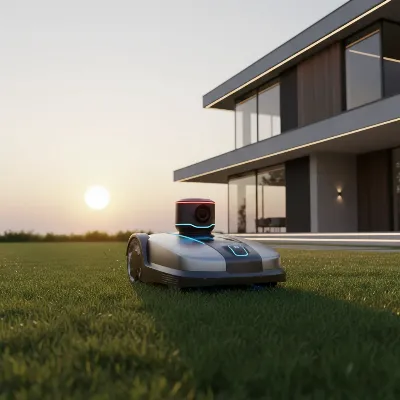 Ecovacs Goat A3000 robot lawn mower operating in a modern smart home garden with integrated lighting.
Mammotion LUBA mini AWD
The Mammotion LUBA mini AWD is a standout for yards with significant hills, recognized for its impressive slope-handling capabilities (up to 80%). What truly sets it apart is its pioneering combination of LiDAR, RTK, and camera vision, fusing three positioning systems for pinpoint navigation even in complex, shaded, or obstacle-filled areas where other models might falter. This all-wheel-drive system ensures steady traction and control on steep terrains. Its AI mapping feature can autonomously map your garden, offering a truly hands-off experience, though initial mapping takes a bit longer.
Eufy Lawnbot E18
If ease of setup and use are your top priorities for a smaller to medium-sized lawn, the Eufy Lawnbot E18 is an exceptional option. It’s praised for its straightforward installation and user-friendly app, which makes setting no-go zones and scheduling effortless. Despite its compact size, the E18 is packed with smart features, including excellent obstacle avoidance. While primarily designed for flatter lawns with slopes no more than 18 degrees, its efficient performance and smart capabilities make it an ideal companion for homeowners seeking a reliable and easy-to-manage robotic lawn mower that integrates well into a smart home setup.
Comparative Analysis: Smart Robot Mowers at a Glance
Choosing the right robot lawn mower often comes down to specific needs and yard characteristics. Here’s a comparative overview of our top 5 picks to help you make an informed decision:
| Feature | Segway Navimow X390 | Husqvarna Automower 435X AWD | Ecovacs Goat A3000 | Mammotion LUBA mini AWD | Eufy Lawnbot E18 |
|---|---|---|---|---|---|
| Lawn Coverage | Up to 2.5 acres | Up to 0.9 acre | Up to 0.4 acre | Up to 0.2 acre | Up to 0.3 acre |
| Navigation | GPS, RTK, Cellular | Bluetooth, Wi-Fi, GPS | LiDAR, Camera | LiDAR, RTK, Camera | Vision, GPS |
| Connectivity | Wi-Fi, Cellular, App | Bluetooth, Wi-Fi, App | Wi-Fi, App | Wi-Fi, App | Wi-Fi, App |
| Slope Capability | Up to 27 degrees | Up to 35 degrees | Handles slopes well | Up to 80% (approx 38 deg) | Up to 18 degrees |
| Key Smart Feature | Remote control via cellular | Articulated steering, AWD | Dual LiDAR + Camera | Triple positioning | Easy setup, user-friendly app |
| Pros | Excellent for large yards, robust connectivity, precise navigation | Best for challenging slopes, proven reliability, AWD | Superior obstacle avoidance, wire-free, great edging | Unmatched slope handling, advanced multi-sensor navigation | Easy to set up, intuitive app, good value for smaller yards |
| Cons | Higher price point | Requires boundary wire | Single cutting height | Initial mapping time | Best for flatter, smaller yards |
Note: Price ranges can vary significantly based on retailers and promotions.
Choosing the Right Robot Lawn Mower for Your Smart Home
Selecting the ideal robot lawn mower involves more than just picking the most expensive or feature-rich model. It requires a thoughtful assessment of your specific property, lifestyle, and existing smart home infrastructure.
Assess Your Lawn’s Size and Complexity
The first step is to accurately measure your lawn’s area. Different robot mowers are designed for varying coverage capacities. Beyond size, consider the terrain: are there steep slopes, narrow passages, numerous obstacles like trees, flower beds, or garden ornaments? Mowers with AWD and advanced navigation (RTK, LiDAR) are better suited for complex or sloped yards, while simpler, wire-guided models might suffice for smaller, flatter, and less obstructed lawns.
Consider Your Smart Home Ecosystem
Think about how the robot mower will integrate with your current smart home devices. Do you primarily use Amazon Alexa, Google Home, or a different platform? Look for models that offer direct compatibility or support via IFTTT for seamless automation. A robust companion app is also crucial for scheduling, monitoring, and setting virtual boundaries, enhancing the overall smart home experience.
Budget and Long-Term Value
Robot lawn mowers represent a significant investment, with prices varying widely. While budget is a factor, consider the long-term value. A more expensive model with advanced features and durable construction might save you money on maintenance and provide a better experience over time. Factor in potential costs for installation (if professional help is needed for boundary wires), replacement blades, and any subscription fees for cellular connectivity or advanced features.
Essential Features and Personal Preferences
Prioritize the features that matter most to you. Is wire-free navigation a must-have? Do you need superior slope handling? How important are advanced anti-theft systems or rain sensors? Some users might value a quiet operation, while others prioritize precise cutting patterns. Identify your non-negotiables to narrow down your choices effectively.
Importance of Brand Reputation and Support
Investigating the brand’s reputation for reliability, customer service, and warranty is crucial. Established brands often offer better technical support, readily available spare parts, and a community of users for troubleshooting. Reviews from other homeowners and expert publications can provide valuable insights into real-world performance and customer satisfaction.
Optimizing Performance and Longevity: Usage and Maintenance Tips
To ensure your robot lawn mower performs efficiently and lasts for many years, proper usage and regular maintenance are essential. These smart devices, while autonomous, still benefit from a little care.
Safe Operation Practices
Always follow the manufacturer’s safety guidelines. Before operation, clear your lawn of any small objects like toys, pet waste, or garden tools that could damage the mower or pose a hazard. Keep children and pets away from the mowing area during operation. Regular checks of the mowing area for new obstacles or changes in terrain can prevent unexpected issues and ensure the mower runs smoothly and safely.
Routine Maintenance Schedule
Consistent maintenance is key to prolonging your robot mower’s lifespan and ensuring optimal cutting performance. Regularly clean the mower’s underside to prevent grass buildup, which can impede blade movement and affect cutting quality. Inspect and sharpen or replace the blades according to the manufacturer’s recommendations—dull blades tear grass rather than cut it cleanly, impacting lawn health. Check the wheels and sensors for debris, and ensure the charging contacts are clean for efficient battery charging. For battery-powered units, proper battery care, such as storing it in a cool, dry place during off-season, can extend its life.
Troubleshooting Common Issues
Even the most advanced robot lawn mowers can encounter occasional issues. Familiarize yourself with common troubleshooting steps, often found in the user manual or the companion app. Problems like the mower getting stuck, failing to charge, or cutting unevenly can often be resolved with simple checks: ensuring no obstacles are blocking its path, verifying charging station contact, or inspecting blades for damage. Most smart mowers also provide error codes or notifications via their apps, guiding you to specific solutions.
“The advancement in sensor technology, particularly the integration of LiDAR and RTK GPS, has truly revolutionized robot lawn mowers. They are no longer just cutting grass; they are intelligently navigating and adapting to dynamic outdoor environments, making them indispensable for modern smart homes.” – Dr. Alistair Finch, Robotics and AI Specialist.
Conclusion
The evolution of robot lawn mowers into sophisticated smart home devices marks a significant leap in home automation, promising pristine lawns with minimal effort. The top models of 2026, such as the Segway Navimow X390, Husqvarna Automower 435X AWD, Ecovacs Goat A3000, Mammotion LUBA mini AWD, and Eufy Lawnbot E18, showcase the incredible advancements in navigation, connectivity, and performance. By understanding your lawn’s unique characteristics and prioritizing features like advanced navigation, smart home integration, and robust safety measures, you can confidently select a robot lawn mower that not only meets your needs but enhances your smart home experience. Are you ready to reclaim your weekends and let intelligent technology manage your lawn?
Frequently Asked Questions
Frequently Asked Questions
What are the main benefits of a robot lawn mower for a smart home?
Robot lawn mowers offer immense convenience, saving you time and effort by autonomously maintaining your lawn. For smart homes, they integrate with existing systems for automated scheduling, remote control, and intelligent responses to weather or other smart home triggers, enhancing overall home automation and efficiency.
Do robot lawn mowers require a perimeter wire for operation?
Not all modern robot lawn mowers require a physical perimeter wire. Many advanced models in 2026 utilize wire-free navigation technologies like GPS, RTK, LiDAR, or camera vision to map and navigate your lawn precisely, making setup easier and more flexible.
How do robot lawn mowers handle obstacles and steep slopes?
Today's smart robot lawn mowers employ sophisticated sensors (LiDAR, camera, ultrasonic) and AI to detect and avoid obstacles. For slopes, models with all-wheel drive and specialized traction control systems can handle significant inclines, ensuring consistent cutting even on challenging terrains up to 38 degrees.
Can I control my robot lawn mower using my smartphone?
Yes, nearly all smart robot lawn mowers come with a dedicated smartphone app. This app allows you to schedule mowing times, define no-go zones, adjust cutting height, monitor the mower's status, and even receive alerts, often from anywhere in the world if the mower has cellular connectivity.
How often should robot lawn mower blades be replaced for optimal performance?
The frequency of blade replacement depends on your lawn's size, grass type, and how often the mower operates. Generally, blades should be inspected regularly and replaced every 1-3 months for optimal cutting performance. Dull blades can tear grass, leading to an unhealthy lawn.
Are robot lawn mowers safe for use around pets and children?
Modern robot lawn mowers incorporate several safety features, including lift sensors that immediately stop the blades if the mower is picked up or tilted. While designed to be safe, it's always advisable to supervise children and pets, and ensure the lawn is clear of obstacles during operation to prevent accidents.
Choosing the Right Robot Lawn Mower for Your Smart Home
Selecting the ideal robot lawn mower involves assessing your property, lifestyle, and existing smart home infrastructure to find a model that best suits your needs.
Accurately measure your lawn's area and consider its terrain, including slopes, narrow passages, and obstacles. Mowers with AWD and advanced navigation (RTK, LiDAR) are better for complex or sloped yards, while simpler models suit flatter lawns.
Evaluate how the robot mower will integrate with your current smart home devices like Amazon Alexa or Google Home. Look for models with direct compatibility or IFTTT support for seamless automation and a robust companion app for control.
Identify must-have features such as wire-free navigation, superior slope handling, advanced anti-theft systems, or rain sensors. Consider personal preferences like quiet operation or precise cutting patterns to narrow down your choices effectively.
While budget is a factor, consider the long-term value of a robot lawn mower. A more expensive model with advanced features and durable construction might save money on maintenance and provide a better experience over time, factoring in potential installation or subscription costs.
Investigate the brand's reputation for reliability, customer service, and warranty. Established brands often offer better technical support, readily available spare parts, and a community of users for troubleshooting, providing valuable insights into real-world performance.
Get our weekly buyer guide
Practical specs, not advice. Unsubscribe anytime.

The Husqvarna Automower 435X AWD has been a game-changer for my sloped backyard. I was worried about a robot mower getting stuck, but the all-wheel drive really makes a difference. My only minor gripe is that the initial setup took a bit longer than I expected, but once it’s going, it’s fantastic.
I finally pulled the trigger on the Segway Navimow X390 after reading about its precise GPS navigation with RTK support. My yard has some tricky spots and it handles them like a champ. It’s amazing to just set it and forget it, and my lawn has never looked better. Definitely worth the investment for a truly smart lawn.
The Ecovacs Goat A3000 is everything I hoped for and more. The seamless integration with my smart home ecosystem was a huge selling point, and it works perfectly with my other devices. It’s so satisfying to control my lawn care from my phone, and the lawn always looks perfectly manicured.
I got the Eufy Lawnbot E18 because it seemed like a good entry-level option. It does a decent job on my flat lawn, but I’ve noticed it sometimes misses small patches, especially near the edges. It’s convenient, but I might upgrade to something with more advanced navigation next season for better coverage.