Few things are as satisfying as a perfectly manicured lawn, with every blade of grass cut to a uniform height. But then there’s that moment of dread: you step back after a long mowing session, only to see unsightly stripes, scalped patches, or a simply uneven finish. It’s frustrating, to say the least, and it immediately tarnishes all your hard work. An uneven cut isn’t just an aesthetic annoyance; it can also harm the health of your lawn, leaving grass vulnerable to disease and browning. As someone who has spent over a decade diagnosing and repairing countless lawn mowers, from the simplest push models to the most advanced robotic units, I understand these problems inside and out. The good news is that many common causes of an uneven cut on your riding lawn mower can be resolved with a bit of DIY know-how. This comprehensive guide will walk you through the troubleshooting steps and provide practical solutions to help you restore your lawn to its pristine condition and ensure your riding mower delivers that consistently clean cut you deserve.
Understanding the Uneven Cut Problem
An uneven cut fundamentally means that your lawn mower blades are not cutting all the grass at the same height across the entire width of the cutting deck. This can manifest in various ways: stripes of taller and shorter grass, patchy areas, or even scalped spots where the grass is cut too short, exposing the soil. A truly even cut is the hallmark of a healthy lawn and a well-maintained mower. When grass is cut cleanly and uniformly, it recovers faster, grows more densely, and is less susceptible to environmental stress, pests, and diseases. Conversely, a ragged or uneven cut can leave grass blades with frayed edges, which turn brown quickly and create an entry point for pathogens. Beyond the health of your turf, an even cut contributes significantly to your lawn’s overall aesthetic appeal, making your property look tidier and more cared for. Recognizing the specific pattern of your uneven cut can often be the first clue in diagnosing the underlying issue. Are the stripes always on one side? Is it consistently higher in the middle? Noticing these details can help narrow down the culprits.
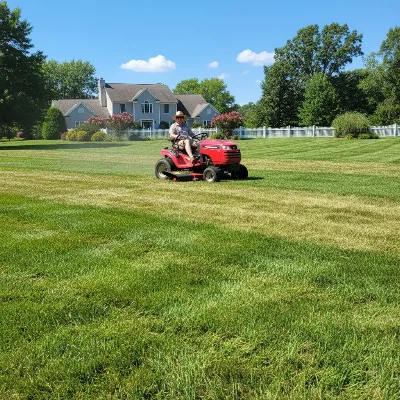 A riding lawn mower on a lawn with a visibly uneven cut, showing distinct stripes and patches.
Diagnosing the Cause of an Uneven Cut
Before you start wrenching on your riding mower, a thorough diagnosis is essential. Many factors can contribute to an uneven cut, ranging from simple adjustments to worn-out components. Taking the time to systematically check each potential cause will save you frustration and ensure you address the real problem. Remember to always prioritize safety before beginning any inspection or repair. Park your mower on a flat, level surface, engage the parking brake, turn off the engine, remove the ignition key, and disconnect the spark plug wire to prevent accidental starting.
Tire Pressure and Level Ground Check
One of the most overlooked, yet critical, factors affecting your mower’s cut quality is tire pressure. Inconsistent or incorrect tire pressure, especially on a riding mower, can cause the entire machine, and thus the cutting deck, to sit unevenly. Imagine trying to cut a straight line with a wobbly table; the same principle applies here. If one tire is underinflated, that side of the mower will sit lower, causing its blades to cut shorter. Start by checking the recommended tire pressure in your operator’s manual. Typically, riding mower tires have specific PSI (pounds per square inch) recommendations, often around 10 PSI for rear tires and 14 PSI for front tires, but always consult your specific model’s manual. Use a reliable tire pressure gauge and ensure all tires are inflated to their specified pressures and are balanced. This step is fundamental to ensuring a level starting point for your deck. Additionally, always make sure you are operating your mower on relatively level ground; extreme slopes or uneven terrain can naturally lead to an uneven cut, even with a perfectly adjusted machine.
Inspecting Mower Blades: Dull, Bent, or Unbalanced
Mower blades are the primary cutting tools, and their condition directly impacts the quality of your cut. Over time, blades naturally become dull from regular use, especially if they encounter small stones, twigs, or other debris in the yard. A dull blade tears grass rather than slicing it cleanly, leaving ragged, brown tips and an uneven appearance. Worse, a bent or damaged blade can cause significant problems. If you’ve ever accidentally hit a hidden object, your blade might be bent, leading to a noticeable wobble or imbalance during operation. This wobble translates directly into an uneven cut, where one side of the blade cuts lower or higher than the other as it spins. To inspect your blades, carefully remove them (refer to your manual for specific instructions) and examine their edges for dullness, nicks, or bends. Also, check for balance. An unbalanced blade can cause excessive vibration, which not only affects cut quality but can also lead to premature wear on your mower’s spindle bearings and other components.
Deck Leveling Issues: Front-to-Back and Side-to-Side
The mower deck itself must be properly leveled for an even cut. There are two critical aspects to deck leveling: side-to-side and front-to-back. If the deck is misaligned from side to side, one side of the deck will be closer to the ground than the other, resulting in a significantly uneven cut across the mower’s width. This often appears as a “stair-step” pattern in your lawn. The front-to-back pitch is also important. Most manufacturers recommend that the front of the cutting deck be slightly lower than the rear (typically 1/8 to 1/2 inch). This slight downward tilt allows the blades to cut the grass cleanly before the clippings are discharged, preventing double-cutting and ensuring proper airflow for efficient bagging or mulching. If the deck’s front is too high, it can lead to uncut strips of grass. If the front is too low, it might scalp the lawn or cause the blades to hit the ground more frequently. Misalignment can happen over time due to impacts, worn components, or simply the vibrations of regular use.
Worn or Damaged Deck Components: Spindles, Belts, Wheels
Beyond the blades themselves, several other components within the mower deck assembly can contribute to an uneven cut if they are worn or damaged.
- Spindles and Bearings: The spindles are shafts that hold the blades and allow them to rotate. If the bearings within the spindles become worn or damaged, they can develop excessive play, causing the blades to wobble. This wobble directly translates to an uneven cut and can also lead to increased vibration.
- Belts: The blade belt transfers power from the engine to the spindles, making the blades spin. A worn, loose, or damaged belt can slip, causing the blades to spin inconsistently or at reduced speeds, leading to a choppy, uneven cut.
- Deck Wheels/Rollers: Many riding mower decks have anti-scalp wheels or rollers that help the deck float over uneven terrain. If these wheels are damaged, missing, or improperly adjusted, the deck can dip and scalp areas of the lawn or ride too high, causing an uneven cut. Ensure they are set at the correct height, typically 1/2″ to 1″ off the ground, as per your manual.
- Damaged Deck Housing: In rare cases, the mower deck housing itself can become bent or warped, perhaps from a severe impact. A deformed deck can prevent the blades from operating at a consistent height, leading to an uneven cut that is difficult to correct through adjustments alone.
Operator Error and Mowing Conditions
Sometimes, the issue isn’t with the mower itself but with how it’s being operated or the conditions in which you’re mowing.
- Mowing Speed: Mowing too fast doesn’t give the blades enough time to cut the grass cleanly. This can result in alternating stripes of taller and shorter turf or ragged grass tips. Slowing down, especially in thick or tall grass, allows the blades to do their job effectively.
- Turning and Maneuvering: Sharp turns or abrupt changes in direction can cause the mower deck to tilt or dig into the turf, leading to scalping or uneven patches. Gradual turns are always recommended.
- Cutting Wet Grass: Mowing wet grass is generally a bad idea. Wet clippings tend to clump and stick to the underside of the deck, impeding airflow and preventing the blades from cutting properly. This buildup can also throw off the blade’s balance and lead to an uneven cut. Wait for the grass to be dry for the best results.
- Uneven Terrain: While riding mowers are designed to handle some variations, extremely bumpy or hilly terrain can make it challenging to achieve a perfectly even cut, even with a well-adjusted deck. Consider leveling particularly problematic areas of your lawn if they consistently lead to uneven cuts.
Essential Tools for DIY Repair
Before you embark on any repair, gathering the right tools is crucial. Having everything on hand will make the process smoother, safer, and more efficient. Here’s a list of commonly needed items:
- Socket and Wrench Set: For loosening and tightening bolts, especially when removing blades or adjusting deck linkages.
- Tape Measure or Deck Leveling Gauge: Essential for accurately measuring blade height from the ground to ensure precise leveling. Some mowers come with a specific leveling gauge.
- Tire Pressure Gauge and Air Compressor/Pump: To check and adjust tire pressures accurately.
- Work Gloves: To protect your hands from sharp blades and greasy components.
- Safety Glasses: Crucial for eye protection during any work involving blades or moving parts.
- Block of Wood or Jack Stands: To safely prop up the mower deck or the entire front of the mower if needed for access. Never rely solely on a jack.
- Blade Sharpening Tool (File or Grinder) or Replacement Blades: For addressing dull or bent blades.
- Wire Brush or Scraper: For cleaning accumulated grass clippings from the underside of the deck.
- Operator’s Manual: Always refer to your specific mower’s manual for detailed instructions, recommended tire pressures, and torque specifications.
Step-by-Step Guide to Fixing an Uneven Cut
With your tools ready and safety precautions in place, let’s dive into the practical steps to fix that uneven cut.
Checking and Adjusting Tire Pressure
This is always your first step, as it forms the foundation for a level deck.
- Park on a Flat Surface: Ensure your riding mower is on a perfectly flat, level surface, like a garage floor or concrete driveway.
- Safety First: Turn off the engine, engage the parking brake, remove the key, and disconnect the spark plug wire.
- Check PSI: Use your tire pressure gauge to check the pressure in all four tires.
- Inflate to Spec: Adjust the inflation of each tire to the PSI recommended in your operator’s manual. It’s critical that both front tires match each other, and both rear tires match each other. Uneven pressure, even by a few PSI, can significantly affect the deck’s level.
- Recheck: After inflation, recheck all pressures to confirm consistency.
Inspecting and Replacing/Sharpening Mower Blades
Dull or damaged blades are a prime suspect for an uneven cut.
- Safety Precautions: With the mower off, key removed, and spark plug disconnected, ensure the blades cannot accidentally engage.
- Access Blades: Depending on your mower model, you might need to safely lift the front of the mower using a jack and secure it with jack stands, or simply access them by looking under the deck.
- Inspect Blades: Carefully examine each blade for dull edges, nicks, bends, or cracks. If a blade is severely bent or cracked, it must be replaced.
- Sharpening: If blades are dull but otherwise in good condition, they can be sharpened. Use a file or grinder to create a sharp edge, maintaining the original blade angle. Be sure to sharpen both sides evenly to maintain balance.
- Balancing: An unbalanced blade will vibrate and cause an uneven cut. You can check the balance using a blade balancer tool. If it’s unbalanced, remove a small amount of metal from the heavier side until it balances.
- Reinstall Blades: Reinstall the blades securely, ensuring the cutting edge faces the correct direction. Always tighten the blade bolts to the torque specifications found in your operator’s manual. Overtightening or undertightening can be dangerous.
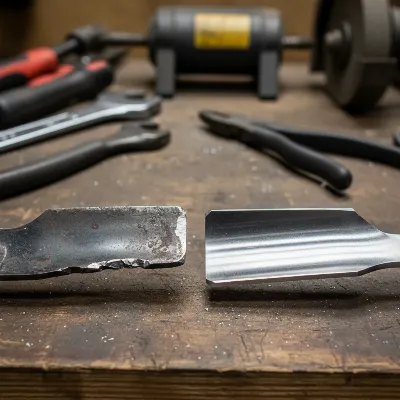 Close-up comparison of a dull, worn mower blade next to a freshly sharpened, clean blade.
Leveling the Mower Deck: Front-to-Back and Side-to-Side
This is often the most critical adjustment for an even cut after addressing tire pressure and blades.
- Preparation: Mower on a flat surface, engine off, key out, spark plug disconnected, parking brake engaged. Ensure tires are correctly inflated.
- Lower the Deck: Lower the mower deck to a mid-range cutting height setting (e.g., 2.5 to 3 inches).
- Side-to-Side Leveling:
- Rotate the blades so they are perpendicular to the mower’s chassis (pointing from side to side).
- Measure the distance from the tip of the blade on the left side to the ground. Repeat this on the right side.
- The measurements should be within 1/8 inch of each other.
- If adjustments are needed, locate the lift links on each side of the deck. Your manual will show you which nuts or bolts to loosen and turn to raise or lower each side of the deck. Typically, turning a nut clockwise raises the deck, and counter-clockwise lowers it.
- Make small adjustments, re-measure, and repeat until the side-to-side measurements are correct.
- Front-to-Back Pitch Adjustment:
- Rotate the blades so they are parallel to the mower’s chassis (pointing from front to back).
- Measure the distance from the tip of the front blade to the ground.
- Measure the distance from the tip of the rear blade to the ground.
- The front blade tip should typically be 1/8 to 1/2 inch lower than the rear blade tip. Consult your manual for the exact specification for your model.
- To adjust, locate the front deck hanger or linkage system. There will be nuts or bolts that allow you to raise or lower the front of the deck. Tighten to raise, loosen to lower.
- Adjust in small increments, re-measure, and repeat until the correct front-to-back pitch is achieved.
- Final Checks: Once adjustments are made, slightly raise and lower the deck a few times, then recheck all measurements to ensure everything remains level.
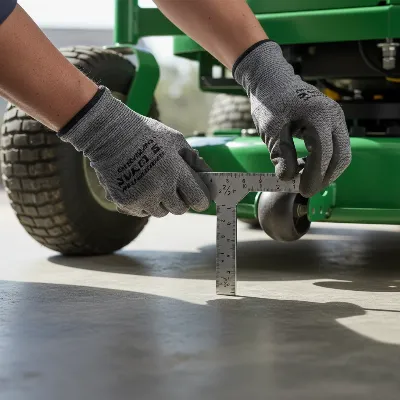 A person using a specialized deck leveling tool to measure the height of a riding lawn mower deck.
Addressing Worn Deck Components
If blade and deck leveling adjustments don’t solve the problem, worn components might be the culprit.
- Inspect Spindles: With the blades removed, try to wiggle the spindle shafts up and down or side to side. Any noticeable play indicates worn spindle bearings, requiring spindle replacement.
- Check Belts: Inspect the blade drive belt for cracks, fraying, or excessive looseness. A worn or stretched belt will not transfer power efficiently. Replace any damaged or overly worn belts, following your manual for proper routing and tensioning.
- Examine Deck Wheels/Rollers: Ensure all anti-scalp wheels or rollers are intact, spin freely, and are adjusted to the correct height (typically slightly off the ground when the deck is at mowing height). Replace any broken or seized wheels.
- Clean the Deck Underside: Accumulated grass clippings and debris on the underside of the deck can interfere with blade rotation, airflow, and even throw off the deck’s balance. Use a scraper or wire brush to thoroughly clean the underside of the deck, ensuring all caked-on material is removed.
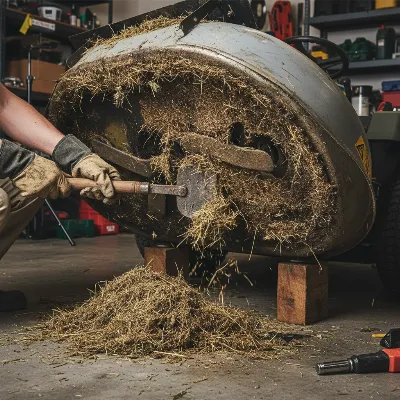 A person using a scraper to remove accumulated grass clippings from the underside of a riding lawn mower deck.
Best Practices for an Even Cut
Beyond repairs, proper mowing techniques can significantly prevent uneven cuts.
- Mow Dry Grass: Always wait for your lawn to be dry. Wet grass clumps, weighs down the blades, and creates an uneven cut.
- Don’t Cut Too Much at Once: Avoid removing more than one-third of the grass blade’s total height in a single pass. If your grass is very tall, raise the deck for the first pass, then lower it for a second pass a few days later.
- Maintain a Consistent Speed: Operate your riding mower at a moderate, consistent speed. Rushing can lead to missed spots and an uneven finish.
- Overlap Your Passes: Overlap each mowing pass by a few inches to ensure no strips are missed.
- Vary Mowing Patterns: Change your mowing direction each time you cut the lawn. This prevents ruts, helps the grass stand up straighter, and promotes a more even cut over time.
When to Call a Professional
While many uneven cut issues are DIY-friendly, there are times when calling a professional technician is the wisest course of action. If you’ve diligently followed all the troubleshooting steps—checked tire pressure, inspected and serviced your blades, meticulously leveled your deck, and examined deck components—and still experience an uneven cut, the problem might be more complex. This could involve issues like a warped mower deck housing, a bent frame on the mower itself, or internal transmission problems affecting blade rotation. These types of repairs often require specialized tools, diagnostic equipment, and in-depth mechanical knowledge that goes beyond typical DIY capabilities. Additionally, if you’re uncomfortable performing any of the steps, particularly those involving blade removal or working under the deck, it’s always better to seek professional help to ensure your safety and avoid further damage to your equipment. A qualified technician can quickly diagnose and fix intricate problems, saving you time, potential frustration, and costly mistakes.
Maintenance Tips to Prevent Uneven Cuts
Preventing an uneven cut is far easier than fixing one. Regular maintenance is the key to ensuring your riding lawn mower always performs at its best and delivers a consistently beautiful finish.
- Routine Blade Care: Make it a habit to check your mower blades regularly, ideally before each mowing season or every 10-15 hours of operation. Sharpen dull blades promptly and replace any that are bent, cracked, or excessively worn. Keeping your blades sharp is perhaps the single most impactful preventative measure.
- Consistent Tire Pressure Checks: Just like checking your car’s tires, make a quick tire pressure check part of your pre-mow routine. Fluctuations in temperature can affect PSI, so consistency is crucial.
- Annual Deck Leveling Check: Even if you don’t notice an uneven cut, it’s good practice to check your deck’s level at least once a year, or more frequently if you often mow rough terrain.
- Keep the Deck Clean: After each use, take a few minutes to clean the underside of your mower deck. Removing accumulated grass clippings prevents buildup that can impede airflow, throw off balance, and encourage rust.
- Inspect Deck Components: Periodically inspect your deck belt for wear and proper tension. Check spindles for excessive play. A proactive approach to identifying and replacing worn parts before they fail can prevent larger issues.
- Store Properly: Store your riding mower in a dry, protected area to prevent rust and corrosion, especially on the deck components.
Conclusion
An uneven cut on your riding lawn mower can be a frustrating problem, but with a systematic approach to troubleshooting and repair, it’s often a fixable issue for the average DIY enthusiast. By diligently checking and adjusting your tire pressure, meticulously inspecting and servicing your mower blades, carefully leveling your deck both side-to-side and front-to-back, and ensuring all deck components are in good working order, you can typically resolve the problem. Remember that regular maintenance and adhering to best mowing practices are your best defenses against future uneven cuts, ensuring your lawn remains a source of pride. Don’t let a patchy lawn get you down; empower yourself with these steps and reclaim that perfect cut. What steps will you take this week to ensure your riding mower is perfectly tuned for a flawless lawn?
Frequently Asked Questions
Why does my riding mower cut higher on one side?
An uneven cut on one side of your riding mower is most commonly caused by an unlevel mower deck or uneven tire pressure. Check your tire pressure first, ensuring all tires are inflated to the manufacturer’s recommended PSI and are consistent. Then, perform a side-to-side deck leveling adjustment to bring both sides of the deck to the same height relative to the ground.
How often should I check my mower deck level?
It’s recommended to check your mower deck level at least once per mowing season, typically at the start. However, if you frequently mow over rough terrain, hit obstacles, or notice a sudden change in cut quality, you should check it more often.
Can dull blades cause an uneven cut?
Absolutely. Dull blades are a very common cause of an uneven cut. Instead of cleanly slicing through grass, dull blades tear the grass, leading to ragged edges, browning, and an inconsistent cutting height across your lawn. Always ensure your blades are sharp and balanced.
What PSI should riding mower tires be?
The ideal PSI for riding mower tires varies by model, so always consult your owner’s manual. However, a common range is 10 PSI for rear tires and 14 PSI for front tires. The critical factor is that all tires on the same axle have equal pressure to maintain a level deck.
What if my lawn mower deck is warped?
If your mower deck is genuinely warped, which can happen from severe impacts, it’s a more serious problem. A warped deck cannot be simply adjusted back into level and will likely require replacement. This is often a job best left to a professional technician to confirm and replace.
Is it normal for the front of my mower deck to be lower than the back?
Yes, it is normal and often recommended for the front of your mower deck to be slightly lower than the rear. This slight downward pitch, typically 1/8 to 1/2 inch, helps the blades cut cleanly and efficiently, preventing uncut strips and ensuring proper grass discharge.
Get our weekly buyer guide
Practical specs, not advice. Unsubscribe anytime.
