Managing a spacious 1-acre yard demands more than just a casual trim; it requires a powerful, efficient, and comfortable solution. For homeowners facing this considerable task, a riding lawn mower becomes an indispensable tool, transforming hours of strenuous effort into a manageable and even enjoyable experience. Selecting the right model, however, can be daunting with countless options available. This comprehensive guide will navigate you through the best riding lawn mowers for 1-acre properties in 2026, exploring different types, top brands, and crucial buying considerations to ensure your lawn remains pristine with minimal fuss.
Overview of Lawn Mowers
A lawn mower is a machine equipped with one or more revolving blades used to cut a grass surface to an even height. Its primary purpose is to maintain a manicured appearance for lawns, sports fields, and other grassy areas. The evolution of the lawn mower has been significant, from the push-reel mowers of the 19th century to today’s sophisticated riding and robotic units. Early designs were purely mechanical, relying on human power, but the introduction of internal combustion engines revolutionized lawn care, leading to self-propelled and eventually ride-on models that dramatically reduced manual labor.
Today’s market offers a diverse range of lawn mowers, each suited to different yard sizes, terrains, and user preferences. For properties around 1 acre, the focus shifts predominantly to more robust and time-saving machines. While smaller yards might suffice with push or self-propelled mowers, the sheer size of an acre often necessitates the efficiency and comfort provided by riding lawn mowers. These powerful machines come in various configurations, including lawn tractors, zero-turn mowers, and compact rear-engine models, each designed to handle the unique challenges of larger landscapes. For lawn mower buying guides on this site.
Understanding Different Lawn Mower Types
The world of lawn mowers is vast, encompassing a spectrum of designs tailored for various needs. While our focus remains on riding mowers for 1-acre yards, understanding the broader categories provides context for why certain types excel in this specific application.
Push Mowers
Push mowers, both reel and rotary, are manually operated machines requiring the user to physically push them across the lawn. They are characterized by their simplicity, lack of engine noise, and zero emissions. Typically, push mowers are best suited for small, flat lawns up to a quarter of an acre where maneuverability and quiet operation are prioritized over speed and power. For a 1-acre yard, a push mower would be an exceptionally time-consuming and labor-intensive option, making it generally unsuitable.
Self-Propelled Mowers
Self-propelled mowers are a step up from push mowers, featuring an engine that powers the wheels, assisting the user in moving the machine forward. This significantly reduces operator fatigue compared to traditional push models. While more efficient than push mowers, self-propelled units are still primarily designed for medium-sized yards, usually up to half an acre. For a full acre, relying on a self-propelled mower would still entail considerable walking and time, often proving inadequate for the scale of the task.
Riding Lawn Mowers
Riding lawn mowers are the go-to choice for larger properties, including 1-acre yards, offering the user the comfort of sitting while mowing. This broad category encompasses several sub-types, each with distinct advantages.
- Lawn Tractors: These are the most common type of riding mower, resembling a small tractor. They are steered with a steering wheel and are excellent for mowing large, relatively open spaces with gradual slopes. Lawn tractors are versatile, often capable of handling various attachments like trailers, aerators, and snow blades, making them useful for year-round yard maintenance. Models like the John Deere S120 or Husqvarna YTH24V54 are popular for their robust engines and cutting capabilities for acres up to two.
- Zero-Turn Mowers (ZTRs): Known for their exceptional maneuverability, zero-turn mowers can pivot 180 degrees, allowing them to turn on a dime. This makes them incredibly efficient for yards with numerous obstacles like trees, flower beds, or complex landscaping where precise navigation is key. ZTRs often feature lap bar controls instead of a steering wheel, providing responsive handling and significantly reducing mowing time. The Husqvarna Z254 and Ryobi Brushless 42-inch Electric Zero Turn are prime examples of this agile design.
- Rear-Engine Riding Mowers: These compact riding mowers typically feature the engine located at the rear, offering better visibility and a smaller footprint than lawn tractors. They are often a good bridge between a walk-behind mower and a full-sized lawn tractor, suitable for yards with narrow gates or tight spaces. While less common for a full acre, some models offer sufficient power and cutting width for properties requiring compact maneuverability.
Robotic Lawn Mowers
Robotic lawn mowers are autonomous machines that cut grass within a defined perimeter. They are quiet, emission-free, and require minimal human intervention once set up. While traditionally designed for smaller lawns, advancements have led to models capable of managing larger areas, sometimes up to an acre or more. However, for a full acre, especially with complex terrain or significant obstacles, their efficiency might still be limited compared to riding mowers, and their initial cost can be higher. They represent a hands-off approach to lawn care, suitable for those prioritizing convenience above all else.
Gas-Powered Mowers
Gas-powered mowers utilize an internal combustion engine, typically running on gasoline, to operate their blades and often propel the machine. They are renowned for their raw power, extended run times, and ability to tackle thick, wet grass and challenging terrain without performance degradation. Most heavy-duty riding mowers, including many lawn tractors and zero-turns, are gas-powered. While powerful, they require regular maintenance like oil changes, spark plug replacements, and fuel system care, and they produce emissions and significant noise.
Electric and Battery-Powered Mowers
Electric mowers can be either corded or battery-powered. For a 1-acre yard, corded electric mowers are impractical due to the limited range and tripping hazards of extension cords. Battery-powered riding mowers, however, are an increasingly viable option. They are quiet, produce zero emissions, and require less maintenance than their gas counterparts. Advances in battery technology have significantly improved run times and power output, with some models offering performance comparable to gas engines. The EGO Power+ ZT4204L and Ryobi Electric Tractor are excellent examples of powerful battery-powered riding mowers suitable for 1-acre properties, offering impressive run times on a single charge.
Comparison Table of Lawn Mower Types
Choosing the right lawn mower for a 1-acre yard involves weighing various factors. The following table provides a comparison across different types, helping to highlight their suitability for larger properties.
| Feature | Push Mower | Self-Propelled Mower | Riding Lawn Mower (Tractor) | Riding Lawn Mower (Zero-Turn) | Robotic Lawn Mower |
|---|---|---|---|---|---|
| Yard Size Suitability | Very Small (<0.25 acre) | Small-Medium (<0.5 acre) | Large (0.5-3 acres) | Large-Very Large (1-5+ acres) | Small-Large (up to 1+ acre) |
| Effort Required | High | Medium | Low | Low | Very Low (Automated) |
| Mowing Speed | Slow | Moderate | Fast | Very Fast | Slow (Continuous) |
| Maneuverability | High | High | Moderate (wide turns) | Excellent (0-inch turn) | Good (within boundaries) |
| Terrain Handling | Flat, light grass | Flat-Slightly Sloped | Varied, moderate slopes | Varied, moderate slopes | Flat-Slightly Sloped |
| Cost | Low | Low-Medium | Medium-High | High | High-Very High |
| Maintenance | Low | Low-Medium | Medium-High | Medium-High | Medium |
| Noise Level | Very Low | Medium | High (Gas), Medium (Electric) | High (Gas), Medium (Electric) | Very Low |
| Fuel Type | None | Gas/Electric | Gas/Electric | Gas/Electric | Electric (Battery) |
| Best For | Small, quiet areas | Medium yards, some inclines | Large, open yards, versatile | Large yards with obstacles, speed | Automated, hands-off care |
> “For a 1-acre property, while push and self-propelled mowers are technically possible, they are highly inefficient. A riding mower becomes a necessity to save time and effort, with zero-turns offering unparalleled agility for complex landscapes.” – Alex Miller, Groundskeeping Supervisor
Top Riding Lawn Mower Brands for 1 Acre Yards in 2026
Several manufacturers consistently produce high-quality riding lawn mowers well-suited for 1-acre properties. These brands are recognized for their innovation, reliability, and performance.
- John Deere: A household name in lawn care, John Deere offers a range of robust lawn tractors ideal for 1-acre yards. Models like the S120 and S130 are celebrated for their durability, powerful engines (often V-twin), comfortable operation, and versatility with available attachments. They are known for providing a smooth, reliable performance and excellent cut quality.
- Husqvarna: Husqvarna is a leader in outdoor power equipment, with excellent riding mowers designed for efficiency and user comfort. Their YTH24V54 lawn tractor is a popular choice, featuring a powerful Briggs & Stratton engine and a wide cutting deck for efficient coverage. For those seeking superior maneuverability, the Husqvarna Z254 zero-turn mower stands out with its powerful engine and air induction technology, ensuring a clean cut even in challenging conditions.
- Ryobi: Ryobi has made significant strides in the electric riding mower market, offering powerful and eco-friendly options. Their Brushless 42-inch Electric Zero Turn Riding Mower offers exceptional agility with joystick steering, making it easy to navigate complex yards. The Ryobi Electric Tractor (80V HP system) provides gas-like power without emissions or extensive maintenance, ideal for environmentally conscious homeowners.
- EGO Power+: Known for its innovative battery technology, EGO Power+ delivers impressive performance in electric zero-turn mowers. The EGO Power+ ZT4204L is a standout, offering the power equivalent of a 22-horsepower gas engine with extended run times and fast charging capabilities. These models are praised for their quiet operation and low maintenance.
- Toro: Toro is a reputable brand, especially known for its zero-turn mowers that emphasize maneuverability and efficiency. The Toro TimeCutter series, such as the SS4225, offers excellent cutting performance and agile handling, making quick work of 1-acre properties with trees or garden beds. Their designs often focus on user comfort and intuitive controls.
- Cub Cadet: Cub Cadet produces a wide array of riding mowers, from compact lawn tractors to powerful zero-turns. Their XT1 Enduro series lawn tractors are a strong contender for 1-acre yards, offering reliable Kohler engines, comfortable seating, and a tight turning radius. The Cub Cadet CC30H is also a popular choice for those seeking a compact yet capable riding mower.
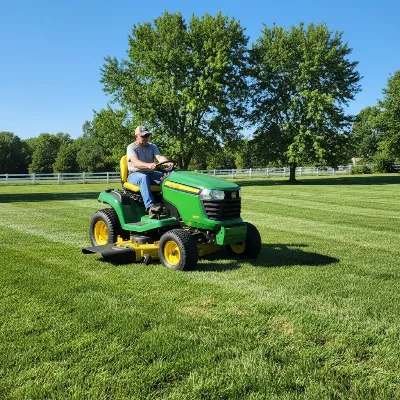 A bright green John Deere lawn tractor mowing a lush 1-acre green lawn on a sunny day.
Buying Guide: Choosing the Right Riding Lawn Mower for Your 1-Acre Yard
Selecting the perfect riding lawn mower involves more than just picking a popular brand; it requires a thoughtful assessment of your specific needs and the characteristics of your yard. For a 1-acre property, certain features and considerations become paramount.
Assess Your Yard: Area, Terrain, and Obstacles
Before anything else, carefully evaluate your lawn. Is your 1-acre yard mostly flat, or does it have slopes and uneven terrain? Are there numerous trees, flowerbeds, or other obstacles that require precise navigation?
A flat, open acre might be best served by a lawn tractor for its speed and versatility with attachments. Conversely, a yard with many tight corners or landscaping features will significantly benefit from the agility of a zero-turn mower, which can dramatically reduce mowing time. Consider the width of gates or pathways if you need to maneuver the mower between different sections of your property.
Budget Considerations
Riding lawn mowers represent a significant investment, with prices varying widely based on type, brand, engine size, and features. Establish a realistic budget before you start shopping. While it might be tempting to opt for the cheapest model, remember that higher-quality mowers often offer better durability, performance, and a longer lifespan, potentially saving money on repairs and replacements in the long run. Electric models may have a higher upfront cost but offer savings on fuel and maintenance.
Essential Features
Several key features directly impact a riding mower’s performance and your mowing experience for a 1-acre yard:
- Cutting Deck Size: For an acre, a cutting deck of 38 to 54 inches is generally recommended. A wider deck (48-54 inches) will cover more ground with each pass, reducing your mowing time. However, ensure the deck size is appropriate for navigating any narrower sections of your yard.
- Engine Power (HP): For efficient mowing of a 1-acre yard, aim for an engine with at least 14-16 horsepower (HP). More powerful engines (18-26 HP), often found in V-twin configurations, handle thicker grass, tougher terrain, and attachments more effectively, providing smoother operation and extending the mower’s lifespan.
- Transmission Type: Hydrostatic transmissions are highly recommended for their ease of use. They allow for seamless speed changes without manual shifting, similar to an automatic car. Manual transmissions are less common in modern riding mowers for this size property.
- Comfort and Ergonomics: Since you’ll be spending considerable time on your mower, features like an adjustable high-back seat, ergonomic controls, and good suspension (especially for uneven terrain) can greatly enhance your comfort and reduce fatigue.
- Attachments Compatibility: If you plan to use your riding mower for more than just cutting grass—such as hauling carts, aerating, or mulching—ensure it’s compatible with the necessary attachments. Many lawn tractors offer a wide range of accessory options.
Durability and Maintenance
A riding mower is an investment, so its longevity is crucial. Look for models with sturdy frames, durable cutting decks (often stamped or fabricated steel), and reliable engine brands. Researching common issues and the availability of parts for specific models can also be beneficial.
Consider the ease of maintenance. Gas mowers require regular oil changes, spark plug replacements, and air filter cleaning. Electric models offer reduced maintenance but require proper battery care and charging.
Brand Reputation and User Reviews
Established brands like John Deere, Husqvarna, Ryobi, EGO Power+, and Toro have built reputations for quality and customer support. Reading user reviews can provide valuable insights into real-world performance, common quirks, and long-term reliability that might not be apparent from specifications alone. Pay attention to feedback regarding performance on 1-acre yards and any mention of customer service experiences.
Safety Features
Prioritize safety. Look for features such as automatic blade shut-off when leaving the seat, headlights for early morning or late evening mowing, and clearly marked controls. Always wear appropriate personal protective equipment, including eye protection and hearing protection, when operating any lawn mower.
Using and Maintaining Your Riding Lawn Mower
Proper usage and consistent maintenance are key to ensuring your riding lawn mower operates efficiently, safely, and lasts for many years. Neglecting these aspects can lead to poor performance, costly repairs, and potential hazards.
Safe Operation Practices
Operating a riding lawn mower requires attention and adherence to safety guidelines. Always read the owner’s manual thoroughly before the first use. Wear sturdy closed-toe shoes, long pants, eye protection, and hearing protection to guard against debris and noise.
Never allow children to operate or ride on the mower. Be mindful of your surroundings, checking for people, pets, or objects before starting and while mowing. Exercise extreme caution on slopes, mowing across the face of a slope with a riding mower, never up and down, to prevent tipping. Always disengage the blades and set the parking brake before dismounting or performing any checks. Never refuel a hot engine.
Routine Maintenance Steps
Regular maintenance is crucial for optimal performance and extending the life of your mower.
- Cleaning: After each use, clean the underside of the cutting deck to remove grass clippings, which can cause corrosion and hinder blade performance. Use a hose and a stiff brush, ensuring the engine is off and spark plug wire disconnected (for gas models) or battery removed (for electric).
- Blade Care: Regularly inspect the blades for sharpness and damage. Dull blades tear grass, leading to an unhealthy-looking lawn. Sharpen blades at least once a season, or more frequently if you encounter tough debris. Replace bent or severely damaged blades immediately.
- Oil Changes (Gas Mowers): Change the engine oil according to the manufacturer’s recommendations, typically after the first few hours of use and then annually or every 50 operating hours. This ensures proper lubrication and prevents engine wear.
- Air Filter: Check and clean the air filter regularly, especially in dusty conditions. A clogged air filter can reduce engine performance and fuel efficiency. Replace it as needed.
- Spark Plugs (Gas Mowers): Inspect spark plugs annually and replace them if they are dirty or worn, as this can affect engine starting and performance.
- Battery Care (Electric Mowers): For battery-powered models, follow the manufacturer’s guidelines for charging and storage. Store batteries in a cool, dry place and ensure they are adequately charged during off-seasons to prolong their lifespan.
- Tire Pressure: Check tire pressure periodically. Properly inflated tires ensure an even cut and better handling.
- Greasing Points: Consult your manual for any greasing points on the mower and lubricate them as recommended.
Troubleshooting Common Issues
Many minor issues can be resolved with basic troubleshooting. If your mower won’t start (gas model), check the fuel level, spark plug, air filter, and ensure the battery is charged. For electric models, verify the battery is fully charged and properly seated. If the mower leaves an uneven cut, check blade sharpness, tire pressure, and ensure the cutting deck is level. Unusual noises often indicate loose parts, worn belts, or blade issues; shut off the mower immediately and investigate. Always refer to your owner’s manual for specific troubleshooting steps and contact a certified technician for more complex problems.
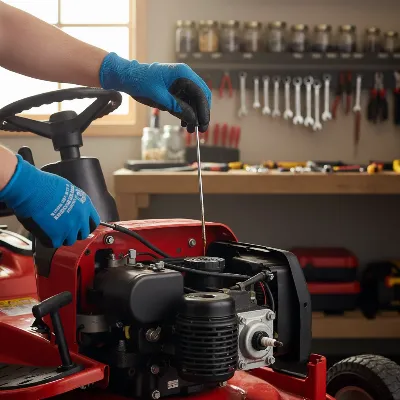 A person performing routine maintenance on a riding lawn mower in a garage setting, checking the oil.
Conclusion
Choosing the best riding lawn mower for a 1-acre yard in 2026 is a decision that significantly impacts your lawn care routine, transforming it from a chore into a more enjoyable task. Whether you opt for the versatile workhorse of a lawn tractor, the agile precision of a zero-turn, or the quiet efficiency of an electric model, the right machine will deliver a pristine lawn with comfort and ease. By carefully considering your yard’s characteristics, understanding key features, and committing to regular maintenance, you ensure your investment provides years of reliable service. What features do you value most in a riding lawn mower, and how do they influence your perfect choice for managing your expansive green space?
Frequently Asked Questions
Is a riding mower necessary for 1 acre?
While technically possible to manage with smaller mowers, a riding lawn mower is highly recommended for a 1-acre yard to significantly reduce mowing time and physical effort, making the task much more efficient and enjoyable.
What is the ideal cutting deck size for 1 acre?
For a 1-acre yard, a cutting deck between 38 and 54 inches is generally ideal. A wider deck, such as 48 or 54 inches, will complete the job faster, but ensure it can navigate any tight spaces in your yard.
Gas vs. electric riding mower for 1 acre?
Gas riding mowers offer robust power and longer run times for heavy-duty tasks and thick grass. Electric riding mowers are quieter, produce zero emissions, and require less maintenance, with modern battery technology providing sufficient power and run time for most 1-acre properties.
How often should I service my riding mower?
Routine maintenance should be performed after each use (cleaning) and annually (oil change, filter check, blade sharpening). Consult your owner’s manual for a detailed service schedule, as specific intervals can vary by model and usage.
What’s the difference between a lawn tractor and a zero-turn?
A lawn tractor is steered with a steering wheel and best for open spaces and hauling attachments, while a zero-turn mower uses lap bars for precise, 0-inch turning radius, making it ideal for yards with many obstacles and maximizing efficiency.
Can I use attachments with all riding mowers?
Not all riding mowers are compatible with attachments. Lawn tractors typically offer the widest range of attachment options, including trailers, aerators, and snow blades. Zero-turn mowers and compact rear-engine models may have fewer options, so check specifications if attachments are a priority.
Get our weekly buyer guide
Practical specs, not advice. Unsubscribe anytime.
