Maintaining a lush, healthy lawn requires more than just regular mowing; it demands careful attention to your equipment, especially your lawn mower’s engine. Just like your car, a lawn mower relies on clean, fresh oil to operate efficiently and prolong its lifespan. Neglecting this crucial maintenance task can lead to serious engine problems and costly repairs. This comprehensive guide, informed by over a decade of hands-on experience, will walk you through everything you need to know about safely changing your lawn mower oil, from recommended frequencies to the right oil types and step-by-step instructions.
Understanding Your Lawn Mower’s Oil Needs
Engine oil is the lifeblood of your lawn mower, performing several vital functions. It lubricates moving parts to reduce friction and wear, helps dissipate heat, cleans by carrying away contaminants, and prevents rust and corrosion. Over time, this oil degrades due to heat, exposure to air, and the accumulation of dirt, dust, and microscopic metal particles. When oil becomes old and dirty, it loses its ability to protect the engine, forcing components to work harder and generate more heat.
Determining how often to change your lawn mower’s oil depends on several key factors. While a general rule exists, specific conditions and usage patterns can significantly alter the ideal schedule. Understanding these variables is crucial for effective maintenance and ensuring your mower remains in peak condition.
When to Change Your Lawn Mower Oil
For most residential lawn mowers, the widely accepted guideline is to change the oil every 50 hours of operation or at least once a year, whichever comes first. This recommendation ensures that even mowers used infrequently still receive fresh oil, as oil can degrade over time simply from exposure to heat and air, even when not actively used. Some experts suggest slightly different intervals depending on the mower type, with push mowers often benefiting from an oil change every 25-30 hours, and riding mowers around every 50 hours.
For brand new mowers, an initial oil change after the first 5 to 10 hours of use is highly recommended. This “break-in” oil change helps remove any metal particles generated during the engine’s initial operation, which can be detrimental if left circulating. While some newer engines are marketed as “no oil change,” it’s generally best practice to still monitor and consider changing the oil to maximize engine longevity, especially if you plan to keep the mower for many years.
Factors that influence oil change frequency include:
- Usage Frequency: Mowers used for large lawns or commercially will accumulate hours faster and require more frequent changes.
- Operating Conditions: Mowing in dusty, dirty, or very hot environments can cause oil to break down more quickly and become contaminated, necessitating shorter intervals.
- Engine Type: Older or smaller engines might be more susceptible to oil degradation and require more regular attention.
- Oil Type: While synthetic oils offer superior protection and can withstand higher temperatures, extending the interval, most manufacturers still advise an annual change.
Signs It’s Time for an Oil Change
Beyond the hour count or seasonal schedule, your lawn mower often gives clear indications when its oil needs attention. Paying heed to these signs can prevent potential engine damage.
- Dark and Dirty Appearance: Fresh oil typically has a clear, amber, or honey-like color. If you check your dipstick and the oil appears dark brown or black, resembling used coffee, it’s a strong sign of contamination and breakdown.
- Gritty Texture: Rub a small amount of oil between your fingers. If it feels gritty or contains fine particles, it indicates the presence of wear metals and dirt, meaning its lubricating properties are compromised.
- Burnt Smell: A distinct burnt odor from the oil is a clear signal that it has been exposed to excessive heat and has begun to break down chemically.
- Decreased Engine Performance: If your mower struggles to start, runs louder than usual, experiences a noticeable loss of power, or sounds rougher, old or low oil could be the culprit.
- Low Oil Level: Regularly checking the oil level is crucial. If it consistently drops below the recommended mark, it not only suggests a need to top up but also indicates that the existing oil may be excessively worn or an issue exists.
|
Our Picks for the Best Lawn Mower in 2026
As an Amazon Associate I earn from qualifying purchases.
|
||
| Num | Product | Action |
|---|---|---|
| 1 | CRAFTSMAN Electric Push Lawn Mower, 20-Inch Deck, Corded, Powerful 13-AMP Motor, 6 Setting Height Adjustment, Winged Blades, 3 in 1 Bagging, Mulching and Discharge (CMEMW213) |

|
| 2 | Litheli 40V (2 x 20V) 16" Electric Lawn Mower Cordless, Brushless Lawnmower with 6-Height Adjust, Portable & Lightweight Push Battery Powered Lawn Mower (2 * 4.0AH Batteries Included) |
|
| 3 | Litheli 20V 13" Cordless Lawn Mower, Electric Lawn Mowers for Garden, Yard and Farm, 5 Heights, with Brushless Motor, 4.0Ah Battery & Charger Included |
|
| 4 | Litheli Electric Lawn Mower Cordless,Grass Cutter Machine for 1300 Sq.Ft.Lawnmower with Motor,13.2 in Cutting Width,8 Gallon Capacity,Cutting Height from 1 to 2.5 in with 4.0A Battery |
|
| 5 | LawnMaster MEB1216K Electric Lawn Mower 16-Inch 12AMP |
|
| 6 | Greenworks 24V 13" Brushless (Push) Cordless Lawn Mower, 4.0Ah Battery and Charger |
|
| 7 | American Lawn Mower Company 50514 14" 11-Amp Corded Electric Lawn Mower, Black |
|
| 8 | LawnMaster MEB1114K Electric Corded Lawn Mower 15-Inch 11AMP |
|
| 9 | VEVOR Push Lawn Sweeper, 21inch Leaf & Grass Collector, Heavy Duty Thickened Steel Durable to Use with Large Capacity 3.5 cu. ft. Mesh Collection Hopper Bag, 2 Spinning Brushes |
|
| 10 | Litheli 13.4inch Electric Lawn Mower Cordless,Grass Cutter Machine for 2600 Sq.Ft.Lawnmower with Brushless Motor, 8 Gallon Capacity, Cutting Height from 1 to 2.5 in, Includes 2X4.0 Ah Battery. |
|
Ignoring these warning signs can significantly shorten your lawn mower’s life and lead to expensive repairs.
Types of Lawn Mower Engine Oils
Choosing the correct type of oil for your lawn mower is just as important as changing it regularly. Most modern lawn mowers use four-stroke engines, which require specific motor oils, distinct from the fuel-oil mix used by two-stroke engines. Always consult your owner’s manual for the manufacturer’s exact recommendations, as using the wrong oil can harm the engine.
Four-Stroke Engine Oils
Four-stroke engines, common in push mowers, riding mowers, and zero-turns, have separate compartments for fuel and oil. Here are the common oil types and their applications:
- SAE 30: This single-grade oil is widely recommended for warmer temperatures, typically above 40°F (4°C). It’s a popular choice for many small engines in moderate climates.
- SAE 10W-30: A multi-grade oil designed for varying temperature ranges, usually between 0°F and 100°F (-18°C and 38°C). The “W” stands for winter, indicating its improved cold-weather flow. While good for cold starts, it might lead to increased oil consumption in very hot conditions (above 80°F/27°C).
- SAE 5W-30: This multi-grade oil provides excellent performance in very cold temperatures, often below 40°F (5°C), or even as low as -20°F (-30°C). It offers improved cold starting with potentially less oil consumption.
- Synthetic SAE 5W-30 / 15W-50: Synthetic oils are engineered to offer superior protection across all temperature ranges, from extreme cold to intense heat. They provide better stability, lubrication, and can extend the life of your engine. While they don’t necessarily extend recommended oil change intervals for typical residential use, they offer enhanced performance. Commercial applications or continuous heavy use might benefit from heavier synthetics like 15W-50.
- High-Quality Detergent Oil: Regardless of viscosity, always use a high-quality detergent oil classified as “For Service SF, SG, SH, SJ” or higher. These ratings ensure the oil contains additives to keep the engine clean and protect against wear. Avoid using special additives not recommended by the manufacturer.
Two-Stroke Engine Oils
Two-stroke engines operate differently, requiring a specific mixture of gasoline and special two-cycle oil. The oil is mixed directly with the fuel, lubricating the engine as it runs. The ratio (e.g., 50:1 or 40:1) is critical and must be precisely followed according to your mower’s manual. Never use four-stroke engine oil in a two-stroke engine, as it will not provide adequate lubrication and can quickly lead to engine failure.
Consequences of Neglecting Oil Changes
Failing to change your lawn mower’s oil regularly can lead to a cascade of problems, significantly impacting performance and shortening the life of your equipment. It’s an investment in preventative maintenance that saves money and headaches in the long run.
“Your mower works hard, and just like any engine, it needs clean oil to stay healthy,” states Brandon Greene, VP of Customer Solutions at Lucas Oil. “Old, dirty oil can cause overheating, excessive wear on parts, and even kill the engine if you ignore it long enough.”
Here’s what can happen if you consistently skip oil changes:
- Increased Friction and Wear: As oil ages, it loses its viscosity and lubricating properties. This leads to increased metal-on-metal friction within the engine, accelerating wear on critical components like pistons, crankshafts, and bearings.
- Overheating: Dirty oil cannot dissipate heat effectively, causing the engine to run hotter than its optimal temperature. Chronic overheating can warp metal parts and compromise engine seals.
- Sludge Buildup: Contaminants like carbon deposits, fuel residues, and dirt accumulate in old oil, forming thick sludge. This sludge can clog oil passages, restrict oil flow, and starve vital engine parts of lubrication.
- Reduced Performance: An engine struggling with poor lubrication will lose power, run rough, consume more fuel, and may become difficult to start.
- Engine Seizure: In severe cases, prolonged lack of lubrication can cause metal parts to fuse together due to excessive friction and heat, leading to a complete engine seizure. At this point, the engine is usually beyond repair, necessitating a costly replacement.
> “If you’re not changing oil regularly, you’re basically running your mower on gunk – the dirt, dust, and other debris that gets kicked up and into the engine, and ultimately the oil.” – Brandon Greene, VP of Customer Solutions at Lucas Oil
A Step-by-Step Guide to Safely Changing Your Lawn Mower Oil
Changing your lawn mower oil is a manageable DIY task that requires basic tools and adherence to safety protocols. By following these steps, you can ensure a clean and effective oil change.
Essential Tools and Supplies
Before you begin, gather everything you’ll need:
- New Engine Oil: Ensure it’s the correct type and viscosity recommended by your mower’s manufacturer.
- Oil Drain Pan: A container large enough to collect all the old oil.
- Funnel: To prevent spills when adding new oil.
- Socket Wrench or Oil Filter Wrench: For removing the drain plug and, if applicable, the oil filter.
- New Oil Filter (if applicable): Riding mowers and some larger push mowers have replaceable oil filters.
- Clean Rags or Shop Towels: For wiping spills and cleaning components.
- Thick Work Gloves: To protect your hands from hot oil and sharp edges.
- Safety Glasses or Goggles: To protect your eyes from splashes.
- Spark Plug Wrench (optional): If you plan to check/clean the spark plug simultaneously.
- Cardboard or Plastic Trough (optional): For mowers without a drain plug, to guide oil when tilting.
Safety Precautions Before You Start
Safety is paramount when working with machinery. Always prioritize these steps:
- Read Your Owner’s Manual: This provides specific instructions and safety warnings for your particular model.
- Ensure a Level Surface: Park your lawn mower on a flat, stable surface. For riding mowers, engage the parking brake.
- Disconnect the Spark Plug Wire: This is a critical step to prevent accidental engine starting while you’re working. Pull the wire away from the spark plug.
- Allow Engine to Cool (Partially): While it’s best to warm the oil for easier draining, ensure the engine isn’t scalding hot before you start handling components. Run it for 1-2 minutes, then turn it off and let it sit for a few minutes.
- Wear Protective Gear: Always wear safety glasses and work gloves.
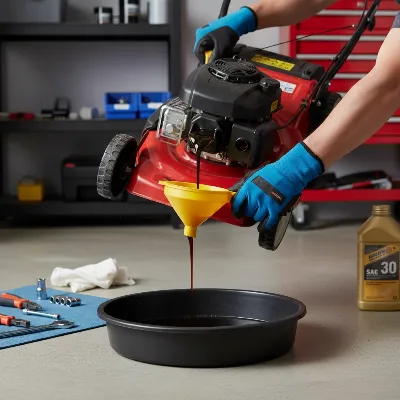 A person safely changing the oil in a lawn mower engine, emphasizing protective gear
Draining the Old Oil
- Locate the Oil Drain Plug: On most push mowers, the drain plug is often a bolt on the underside of the engine or sometimes located on the oil fill tube. For riding mowers, there might be a drain hose or a plug at the bottom of the engine.
- Position the Drain Pan: Place the oil drain pan directly beneath the drain plug or the area where the oil will flow out.
- Remove the Oil Fill Cap/Dipstick: This allows air to enter, facilitating smoother oil flow.
- Remove the Drain Plug: Using your socket wrench, carefully loosen and remove the drain plug. Be mindful that the oil will likely be warm and flow quickly. For mowers without a drain plug, you may need to gently tilt the mower on its side, ensuring the air filter is facing upwards to prevent fuel leakage.
- Allow Complete Drainage: Let the oil drain completely into the pan. This may take several minutes.
- Replace the Drain Plug: Once the oil has fully drained, clean the drain plug and its surrounding area. Reinstall the drain plug securely, but do not overtighten it.
Replacing the Oil Filter (if applicable)
If your lawn mower has an oil filter (typically found on riding mowers and some larger push mowers):
- Position Drain Pan: Move the drain pan beneath the oil filter.
- Remove Old Filter: Use an oil filter wrench to turn the old filter counter-clockwise until it loosens. Be prepared for a small amount of oil to spill out.
- Clean Area: Wipe down the oil filter mounting area with a clean rag.
- Prepare New Filter: Apply a thin film of fresh oil to the rubber gasket of the new oil filter. This helps create a good seal.
- Install New Filter: Screw the new filter on by hand until the gasket makes contact with the engine. Then, tighten it an additional half to three-quarters of a turn using the wrench. Do not overtighten.
Adding New Oil
- Refill with Fresh Oil: Place a funnel into the oil fill tube. Carefully pour the new, recommended oil into the engine. Refer to your owner’s manual for the exact oil capacity. Avoid pouring too quickly to prevent spills.
- Check Oil Level: After adding most of the recommended amount, wait a few minutes for the oil to settle. Insert the dipstick (after wiping it clean), push it all the way in, and then remove it to check the level. The oil should be between the “Add” and “Full” marks. Add small amounts of oil as needed until the correct level is reached. Do not overfill, as this can also cause engine damage.
- Replace Oil Fill Cap/Dipstick: Once the oil level is correct, securely replace the oil fill cap or dipstick.
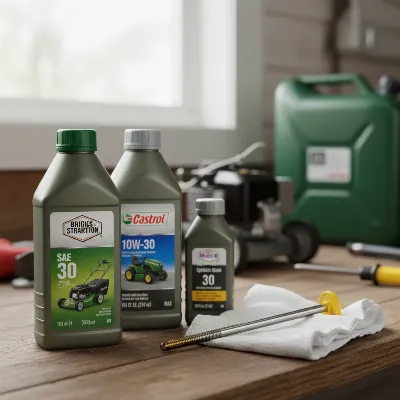 Various bottles of lawn mower oil types and an oil dipstick, illustrating selection
Post-Change Checks and Proper Disposal
- Reconnect Spark Plug Wire: Reattach the spark plug wire firmly to the spark plug.
- Check for Leaks: Start the engine and let it run for a few minutes. Turn it off and check around the drain plug and oil filter (if applicable) for any leaks.
- Dispose of Used Oil: Never pour used motor oil down drains or onto the ground. It is an environmental pollutant. Pour the old oil from your drain pan into an empty, sealable container (like the bottle the new oil came in). Take it to an automotive parts store or a local recycling center that accepts used motor oil for proper disposal.
Common Oil-Related Issues and Troubleshooting
Even with regular maintenance, issues can arise. Understanding common oil-related problems can help you diagnose and address them promptly, preventing further damage to your lawn mower.
Low Oil Level and Its Consequences
A low oil level is one of the most direct threats to your engine. Without sufficient lubrication, metal parts grind against each other, leading to rapid wear, excessive heat, and eventually, engine failure.
- Troubleshooting: Regularly check your oil level before each use, or at least every few uses, using the dipstick. If it’s consistently low, top it up to the “Full” mark. Investigate if there’s a leak (look for oil stains under the mower) or if the engine is burning oil (indicated by blue smoke from the exhaust).
Overfilling the Oil Reservoir
While underfilling is problematic, overfilling the oil can be equally damaging. Too much oil can cause excessive pressure within the crankcase, leading to seal failures and oil leaks. It can also cause the crankshaft to churn the oil, aerating it and forming foam, which reduces its lubricating effectiveness.
- Troubleshooting: If you accidentally overfill, drain a small amount of oil until the level is within the safe range on the dipstick. This might involve loosening the drain plug briefly or using a small oil suction pump.
Using the Wrong Type or Grade of Oil
Using an oil with the incorrect viscosity or specifications can lead to poor lubrication. For example, an oil that’s too thick might not flow well in cold weather, while an oil that’s too thin might not provide adequate protection in hot conditions.
- Troubleshooting: Always refer to your owner’s manual for the precise oil type and grade. If you’ve used the wrong oil, it’s best to drain it immediately and refill with the correct type. Do not mix different types or grades of oil unless specifically advised by the manufacturer.
Engine Overheating
Overheating can stem from several issues, and old, dirty oil is a common contributor. If the oil cannot effectively dissipate heat, the engine temperature will rise. Other factors like a clogged air filter or debris around the engine’s cooling fins can also contribute.
- Troubleshooting: Check your oil’s condition and level. Ensure the air filter is clean and replace it if necessary. Clear any grass clippings or debris from around the engine’s cooling fins. If overheating persists after addressing these, consult a professional.
By being vigilant about oil condition and addressing issues promptly, you can ensure your lawn mower performs reliably and lasts for many seasons.
Conclusion
Regular oil changes are non-negotiable for the health and longevity of your lawn mower’s engine. By adhering to the recommended schedule of every 50 hours of use or annually, and understanding the nuances of oil types and proper change procedures, you can prevent premature wear, avoid costly repairs, and ensure your equipment runs smoothly for years to come. Taking the time for this simple maintenance task is a small investment that yields significant returns in performance and reliability. Don’t let dirty oil turn your trusty lawn mower into a costly headache. What steps will you take this season to prioritize your lawn mower’s oil health?
Frequently Asked Questions
What happens if I never change my lawn mower oil?
If you never change your lawn mower’s oil, it will eventually become thick with contaminants, losing its lubricating and cooling abilities. This leads to increased friction, overheating, accelerated engine wear, and can ultimately cause the engine to seize completely, requiring a full replacement.
Can I use car oil in my lawn mower?
While some 4-stroke lawn mower engines might tolerate certain types of car oil (like 10W-30), it’s generally best to use oil specifically formulated for small engines, as recommended by your mower’s manufacturer. Car oils may have different additive packages not suited for the unique operating conditions of a lawn mower engine. Never use car oil in a 2-stroke engine.
How do I check my lawn mower oil level?
To check your lawn mower oil, first ensure the mower is on a level surface and the engine is cool. Locate the oil fill cap, which often has a dipstick attached. Remove the dipstick, wipe it clean, reinsert it fully, then remove it again. The oil level should fall between the “Add” and “Full” marks on the dipstick.
How much oil does a lawn mower typically hold?
The oil capacity varies by mower type and engine size. Walk-behind mowers often hold between 15 to 18 ounces, while riding mowers typically require 48 to 64 ounces. Always consult your owner’s manual for the exact capacity of your specific model to avoid under- or overfilling.
Is synthetic oil better for my lawn mower?
Synthetic oil offers superior protection and stability across a wider range of temperatures compared to conventional oil, providing enhanced lubrication and potentially less oil consumption. While it may not extend standard annual oil change intervals for residential use, it offers increased engine safeguarding, especially in challenging conditions.
Can I change my lawn mower oil myself?
Yes, changing your lawn mower’s oil is a straightforward DIY maintenance task. With the right tools, new oil, and by following proper safety precautions and step-by-step instructions, most homeowners can successfully perform an oil change without needing professional assistance.
